
How to create an immersive corporate space that truly makes an impact
Immersive corporate spaces help companies turn products, factories and complex technologies into memorable experiences for clients, partners and investors

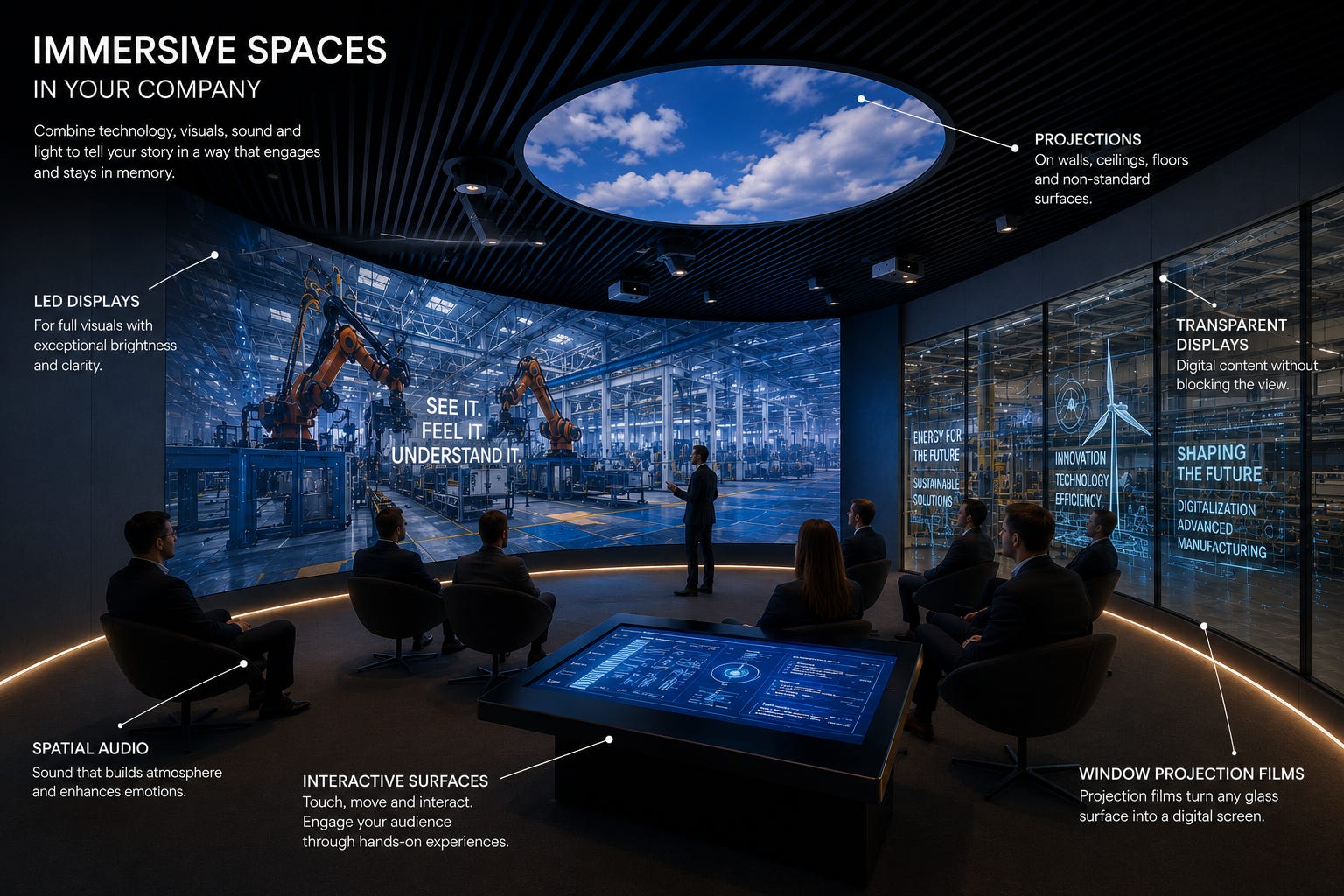
Just a few years ago, a corporate showroom usually meant a few display cases, a screen on the wall, product samples, and a presentation running during customer visits. It worked because expectations were different. Today, however, clients, partners, and investors have seen it all.
Another corporate video, another slide deck, another brochure is rarely enough to help them truly understand the scale of a company, its technology, manufacturing capabilities, or the story behind the brand.
Want immersive room in your space ?
This is why more and more organizations are investing in immersive corporate spaces. Not just conference rooms with larger displays, but environments designed to transport visitors into a different world for a few minutes.
This is also the type of experience-driven thinking explored in publications such as Entertainment Insights and Entertainment Technology, where the future of venues, technology and audience engagement is becoming a recurring theme.
How to take clients to different world
It could be a factory that is difficult to visit. It could be a research center, a production facility, a mine, a port, a laboratory, a real estate development, a hotel, a theme park, or even a product that has not yet been built.
A well-designed immersive space allows visitors not only to see these places but to experience their atmosphere, scale, processes, technology, and purpose.
This is particularly valuable for companies selling products or services that are difficult to demonstrate in a traditional meeting room.
Industrial equipment, infrastructure projects, energy solutions, advanced technologies, logistics operations, and manufacturing processes are often too complex to explain through slides alone. You can talk about them. You can show photos. But true understanding often comes only through experience.
And this is where the real difference begins.
Creating an immersive corporate space is not about mounting a large display on a wall. It is not simply a presentation room with a bigger screen.
The most successful projects are created through a thoughtful balance of technologies, storytelling, architecture, lighting, visuals, sound, and interaction.
In some environments, large-format LED displays will be the ideal solution. In others, transparent displays can create digital content without blocking the view beyond.
Projection films applied to glass can transform ordinary windows into dynamic digital surfaces. Sometimes projection mapping delivers the strongest impact. In other cases, interactive floors, responsive lighting systems, or carefully designed spatial audio become the elements that bring the experience to life.
The key word here is balance.
An immersive environment does not need to overwhelm visitors with technology. The goal is not for a client to leave saying, “That was a huge screen.” The goal is for them to leave feeling as though they were actually inside the factory, standing next to the production line, walking through the research center, or experiencing the project firsthand.
Audio plays an equally important role. It does not need to be loud. Often, subtle spatial sound effects, carefully timed lighting cues, and high-quality visual content create a far more memorable experience than technology used simply for its own sake. Immersion is rarely about excess. It is about creating a seamless and believable experience.
One of the most common mistakes companies make is starting with the question:
“Which display should we buy?”
A much better question is:
“What do we want visitors to feel when they leave this room?”
Do we want them to understand the scale of our manufacturing operations? Do we want them to experience the innovation behind our products? Do we want to communicate trust, quality, sustainability, engineering excellence, or future vision?
Only after answering these questions should technology enter the conversation.
The good news is that these spaces do not need to be built all at once. Some companies choose to create a complete immersive experience from day one. Others begin with a single room and a simple narrative, then gradually expand the concept with additional content, interactive elements, lighting systems, transparent displays, augmented reality applications, or advanced audio solutions.
What matters most is having a long-term vision from the beginning. Even if the first phase is relatively modest, understanding where the space may evolve over the next three to five years helps avoid disconnected investments and technology decisions that may need to be replaced later.
At ARAM, this is how we approach immersive environments.
We do not see them as collections of equipment. We see them as experiences.
For years, ARAM has worked with LED technology, projection systems, lighting design, immersive multimedia, large-scale events, broadcast productions, and experience-driven environments. This perspective allows us to focus not on individual products, but on the emotional and business impact the space creates.
An immersive corporate room can become far more than a showroom. It can support sales presentations, investor meetings, employee onboarding, customer training, product launches, media events, and executive briefings. It can evolve alongside the company, adapting its content and purpose over time.
Because sometimes the best way to show a client your factory is not to take them to the factory.
Sometimes the best solution is to bring the factory to them.
Have a project ? Idea ?


 | A guest post by
|